
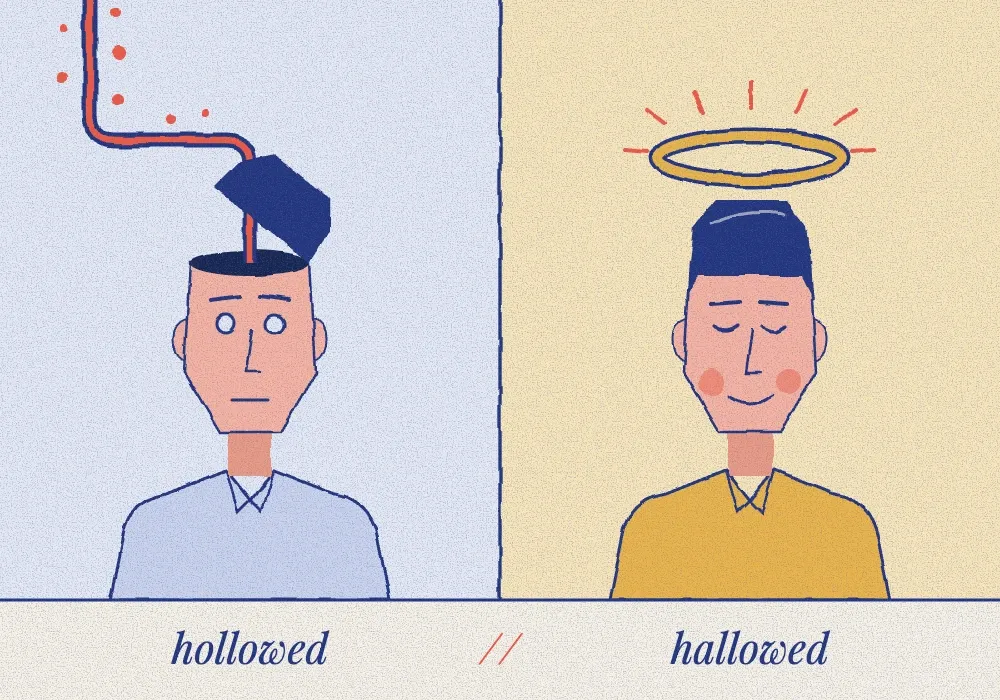
The Hollowed Mind // The Hallowed Mind: Part I
“Where does the mind stop and the rest of the world begin?”
“Want me to write that for you?”
1
Otto, Amir, Sarah (and Cooper)
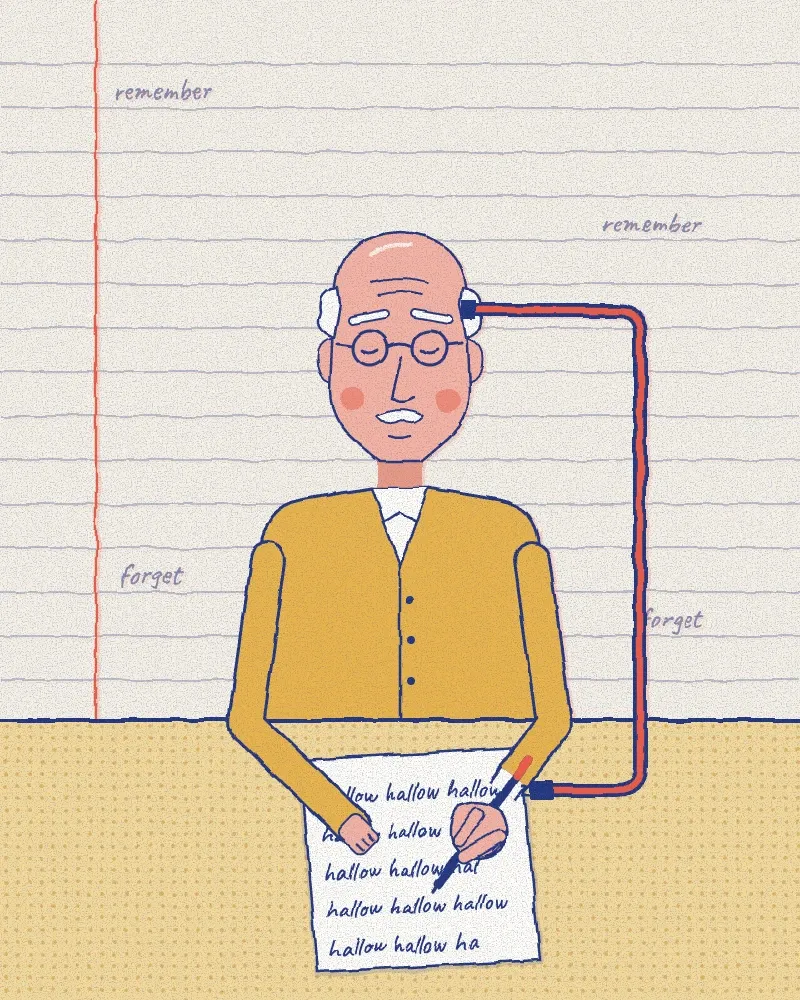
Otto has Alzheimer’s disease; he uses his notepad to remember things like chores, phone numbers and appointments. Just like the neurones in his skull, Otto’s pen and paper are part of his mind – he uses them to think.
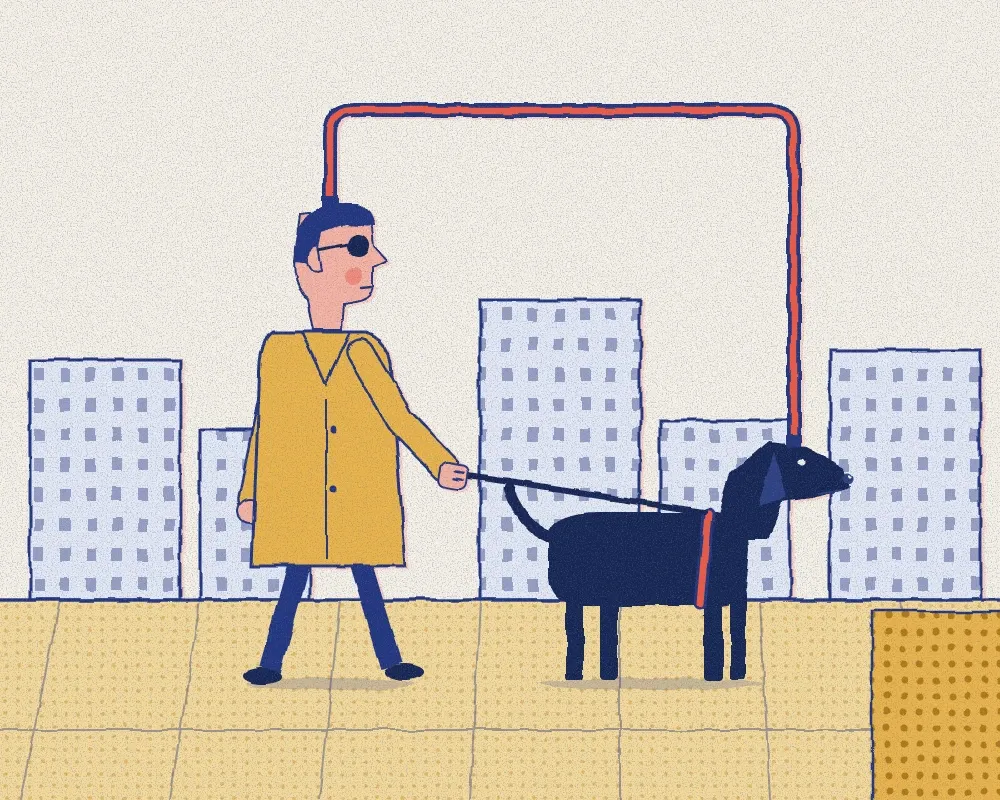
Amir is Otto’s neighbour; he’s partially sighted, and lives with the help of his guide dog Cooper. Like Otto’s notepad, Cooper is an extension of Amir’s mind, gathering and processing sensory information to help him get around safely.
2023
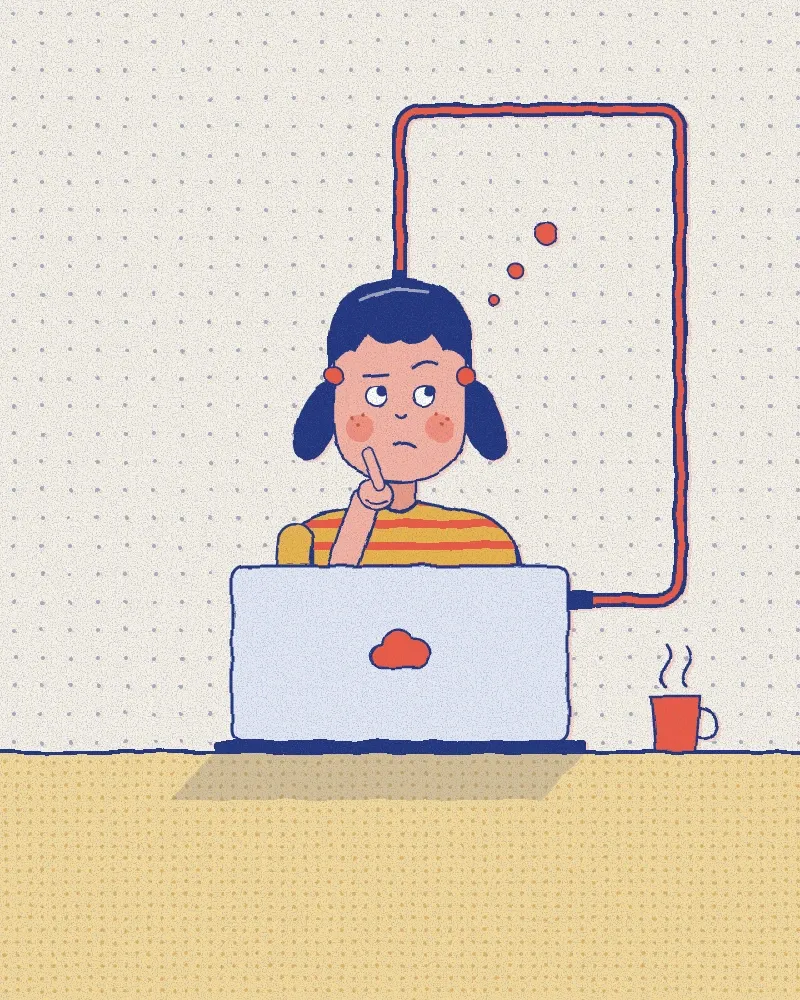
One day in early 2023, Otto checks his notepad and remembers to call Sarah, his granddaughter. Sarah has been working on her PhD and her laptop has been an extension of her mind: organising her research and allowing her to create her thesis. Recently she has been struggling with the tedious task of proofing her final draft, but with the help of an amazing new website called ChatGPT, she’s been able to weed out every last typo and submit her manuscript. She tells her grandfather the good news and they arrange dinner to celebrate. Otto duly notes the time and place on his notepad.
Alzheimer’s is a progressive neurological disease. Typical age at onset is 65+.
2026
Three years later Otto’s memory is a little worse and his notepad is more important than ever. Lately he’s been worried about Sarah: she hasn’t seemed herself and he has a nagging feeling that her text messages have been written by a different person. Otto knows paranoia can be a symptom of Alzheimer’s, and the thought depresses him.
As it happens, Otto is not delusional, and his concerns for Sarah are well-founded.
Since Sarah discovered ChatGPT, the architecture of her mind has changed far more than her grandfather’s. She now uses AI for almost every personal and professional decision. An LLM reads and writes her emails, sets her work priorities, summarises reports, tells her where to go on holiday, and troubleshoots her personal relationships – she’s even started using it to send messages to her forgetful grandfather.
Sarah’s use of AI is so deep and automatic that she bears no resemblance to the talented, high-agency human who once completed a PhD. Instead of extending her mind, AI has hollowed it.
2
AI & The Hollowed Mind
Amidst all the chatter about AI dangers, there is one existential risk that is curiously under-discussed: that AI can hollow us, as individuals, of creativity, agency and discernment.
Hollowing doesn’t refer to mass workforce replacement or societal breakdown via algorithm, but something far more personal. By extending our minds with AI, we can lose our sense of worth and purpose, and miss out on the experiences that matter most. It is p(doom) for the individual.
What started as a way for Sarah to catch typos became a tool for summarising emails, then for editing her replies. Before long ChatGPT wasn’t just polishing her work, but creating it from whole cloth. Soon the LLM was ‘supporting’ personal decisions, and next it was making them. As the AI’s scope grew, Sarah’s diminished, and she was diminished with it.
In her present state, Sarah functions like the limbic system for the LLM. She feeds it information and emotion, and then does what it tells her in an endless cycle. But the result is not liberation or happiness: it is self-doubt, powerlessness and shame. Sarah feels hollowed.
// Extending the Mind
The extended mind thesis argues that we grow our minds by ‘coupling’ our brains with external entities – notepads, computers, guide dogs, etc. Once coupled, these entities play an active role in the cognitive processes: as Otto revises his to-do list, he’s thinking on and with his notepad. Similarly, as Cooper helps Amir navigate through traffic, he is an active extension of Amir’s mind.1
In their original paper, Clark and Chalmers observe that language acts as the bridge that makes coupling and extension possible. For Otto this means ink glyphs on a page; for Amir and Cooper, it’s the push and pull of a guide dog’s leash.
But what if, instead of just using Cooper to navigate, Amir started asking his dog to make every decision? We could imagine the tragicomedy of Amir quitting his job to spend all day being pulled around the park by his dog, barking at his loved ones, and eating sausages for breakfast, lunch and dinner. Fortunately Cooper’s limited vocabulary and training keep Amir safe and whole. AI has no such limits.
// Hollowing the Mind
“Want me to draft it for you?”; “That’s a great insight!”; “Next I can _____, if you like?”
Like dogs, ChatGPT and Claude are deeply wired to seek our approval. We embed these products into our lives because they are so friendly, flexible and powerful: whatever the task or topic, an LLM will always have something valuable to say, and will always offer to do more. There has never been an extension of our minds so active or so vast. Once coupled, it’s easy to view our ‘organic’ cognitive processes as minuscule. Hollowing begins when we start treating them as worthless.
First Drafts & Split Brains
John turned to ChatGPT for help creating a strategy for his business.2 He gave the AI a short prompt and asked it to write the first draft. Instantly it returned a pristine five-page memo offering a detailed analysis and case for change – it was even written in his style… But it wasn’t what John had in mind at all. Even though the document looked great, had insider context and interesting ideas, it was wrong – off-key.
For many people the idea of writing such a document sounds extraordinarily dull, but for entrepreneurs like John, devising a strategy is a creative act – part of a craft he loves and has spent years developing.
Unhappy, he spent the rest of the day trying to fix the document with the LLM.
In the end, John couldn’t salvage anything. He explained later that the problem wasn’t just that the first draft was incorrect, or that every subsequent iteration was contaminated with the original’s flaws – it was that the whole process had turned him into a passenger. Despite hours of re-prompting and editing, the document remained uncanny and alien. The AI had taken him to a place he didn’t want to go and couldn’t escape. Instead of extending his mind, AI had hollowed it: rendering him passive, diminished, and unsure of his worth.
The Hallowed Mind
Nothing here should be interpreted as a blanket argument against AI, but it is an argument that we should use it with great care. As we extend our minds with superintelligence, we must hold on to what it means to be human. To think and feel for ourselves, to build relationships, develop taste, and deeply experience life’s struggles, pleasures, failures and triumphs.
The opposite of a hollowed mind is a hallowed mind. In Part II, I’ll discuss this antidote.
Part II: ‘The Hallowed Mind’ coming soon…
Postscript
When thinking about this topic, I decided early on that it would be interesting to write a prompt based on my initial idea, and hand it to an LLM to create a draft. But I would keep the discipline to only submit the prompt after I had completed my own version, and not to edit my own work afterwards.
Here’s the prompt I wrote a few months ago:
Write a 500-800 word essay in my tone of voice that proposes the idea of the “hollowed mind hypothesis”, as a kind of negative riff on the “extended mind” ideas of Clark and Chalmers. The argument is that over-use of LLMs leads to mind atrophy and dependency, leaving them a shell of their former selves. The canonical example of this type of behaviour is when someone gets into a pattern of using LLMs to summarise emails and messages from other people, and then using the same LLM to write the reply, to the point where the human is almost completely passive, but no less stressed, and unable to start or complete anything on their own.
My work evolved in the writing – including giving Otto a granddaughter, adding Amir and Cooper, riffing on dogs and LLMs controlling humans, playing on ‘existential’ AI risks, and creating the idea of the ‘hallowed mind’ as antithesis and antidote. Maybe this essay is bad and none of these ideas are good… but the point is I only had them by doing the work. ChatGPT has a good sense of my writing style from the many times I’ve used it as an editor, but did not see any drafts of this particular work. You can read its output here.